The Definitive Guide to the Back Squat
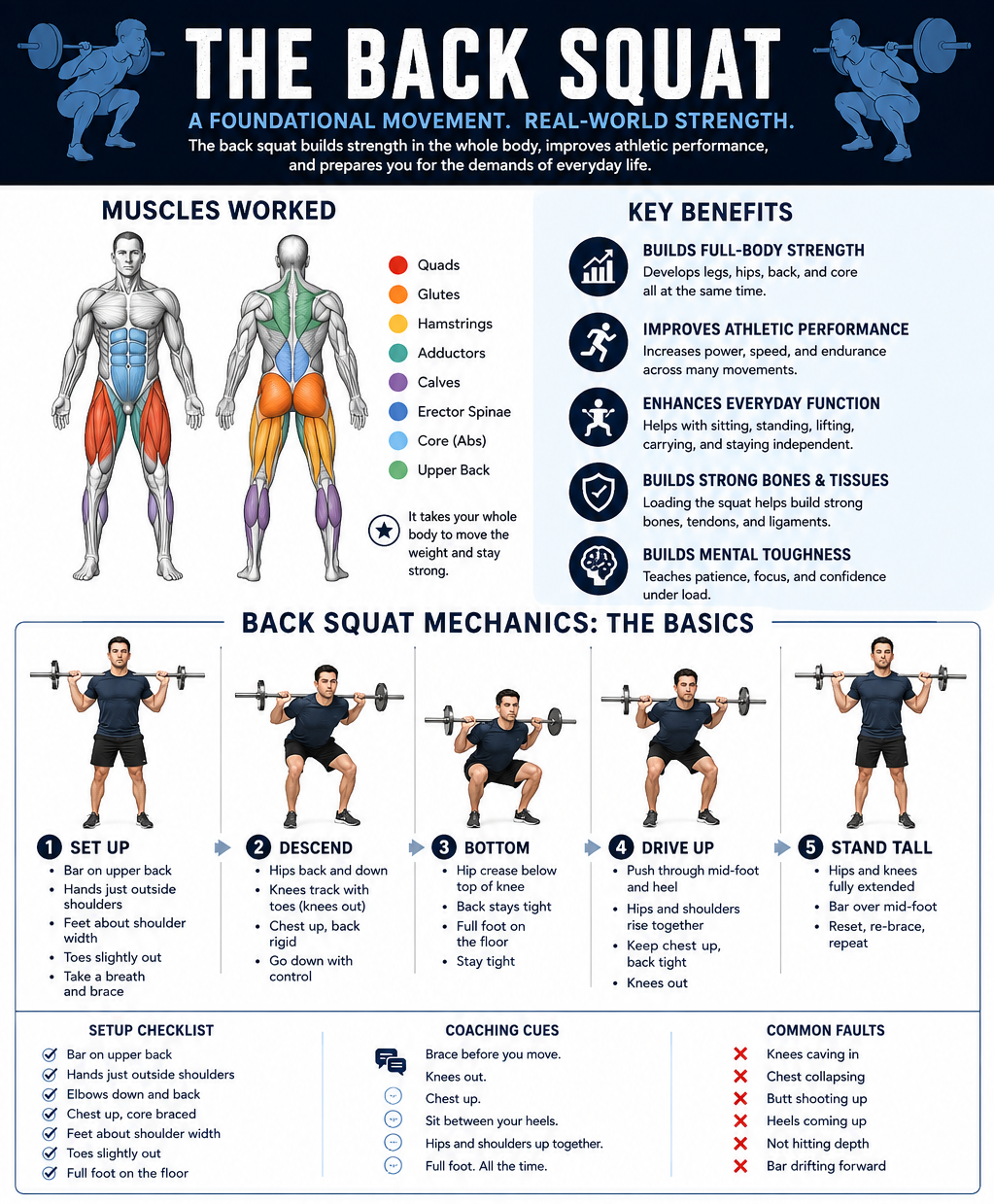
The back squat is one of the most important movements we train.
It is simple, but not easy. A barbell on your back, your feet rooted into the floor, your body braced, and the task is clear: squat down with control and stand up strong.
But the back squat is not just about lifting more weight.
It is about building strength that carries over into life. Strength for running, jumping, lifting, carrying, getting off the floor, playing with your kids, and aging well. It teaches the body how to brace, how to stay tight, how to move through a full range of motion, and how to produce force with the hips and legs together.
That is why we train it.
The Squat Is a Human Movement First
Before the squat is a barbell lift, it is a basic human movement.
We squat when we sit down. We squat when we stand up. We squat when we pick something up from the floor. We squat when we lower ourselves toward the ground and get back up again.
As we age, losing the ability to squat well often means losing independence. Getting out of a chair, getting off the toilet, standing up from the floor, carrying groceries, walking upstairs, and playing with kids or grandkids all require strong legs, strong hips, and a stable trunk.
That is why squatting matters.
The back squat is not just about building bigger legs. It is about building a stronger body that can continue doing hard things for a long time.
Why the Back Squat?
In CrossFit, we use many different types of squats.
The air squat teaches movement quality.
The front squat carries over to cleans.
The overhead squat challenges mobility, balance, and control.
The wall ball teaches us to squat under fatigue.
The thruster combines the squat with upper-body pressing and conditioning.
But when we want to build raw strength through the hips, legs, trunk, and back, the back squat is hard to beat.
With the barbell on the back, we can progressively load the movement over time. That progressive loading is what allows us to get stronger. Rep by rep, week by week, the body adapts to the stress and builds more strength.
The back squat trains the body as a system. Your legs do a lot of the work, but they are not working alone. Your glutes, hamstrings, quads, adductors, spinal erectors, abs, upper back, and even your feet all have a job to do.
A good back squat teaches you how to brace, stay tight, produce force through the floor, and move a heavy load with control.
That carries over.
Stronger squats help your cleans.
Stronger squats help your deadlifts.
Stronger squats help your rowing, biking, running, jumping, lunging, wall balls, thrusters, and box jumps.
Stronger squats help you feel more capable outside the gym.
That is why the back squat has earned its place as one of the most valuable strength movements we train.
High-Bar vs. Low-Bar Back Squat
Not all back squats look exactly the same.
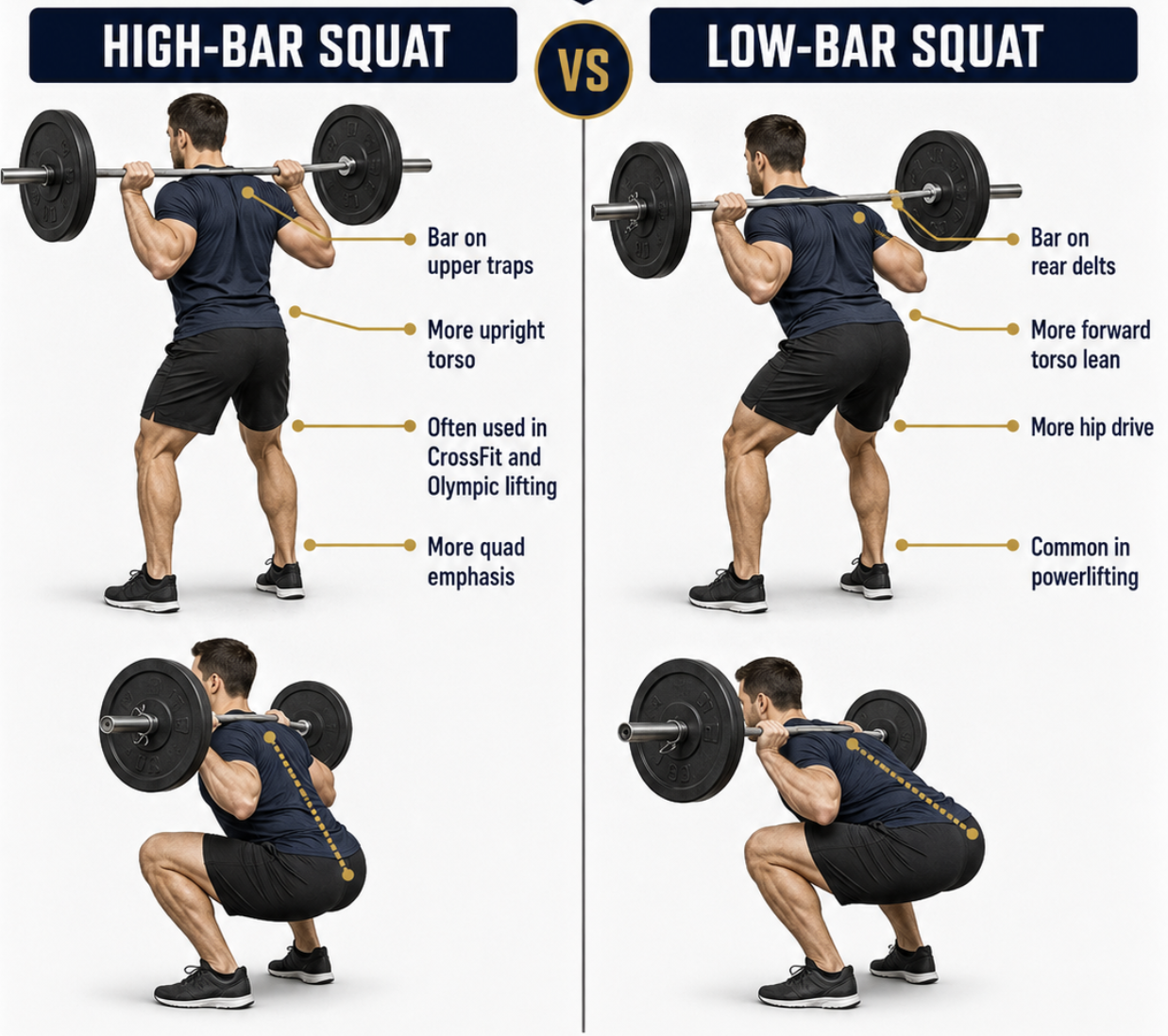
One difference you may hear about is high-bar versus low-bar squat position.
In a high-bar squat, the bar rests higher on the traps, near the top of the shoulders. This position usually allows for a more upright torso and often looks more like the squat positions we use in CrossFit movements such as wall balls, thrusters, cleans, and snatches.
In a low-bar squat, the bar sits slightly lower across the rear delts and upper back. Because the bar sits farther back, athletes often lean forward a bit more and use more hip drive to keep the bar balanced over the middle of the foot.
Neither is automatically right or wrong.
Both are legitimate squat styles. Both build strength. Both require good mechanics.
For most CrossFit athletes, we tend to favor a high-bar position because it transfers well to Olympic lifting and functional movement patterns we use regularly. But depending on your body type, shoulder mobility, goals, injury history, or comfort, some athletes may naturally prefer a slightly lower bar position.
The important thing is not chasing a perfect-looking squat from the internet. The important thing is finding a stable, repeatable position that allows you to squat safely, hit depth, stay balanced, and build strength over time.
The Back Squat Is Not Just a Leg Exercise
One of the biggest mistakes people make is thinking of the squat as only a quad exercise.
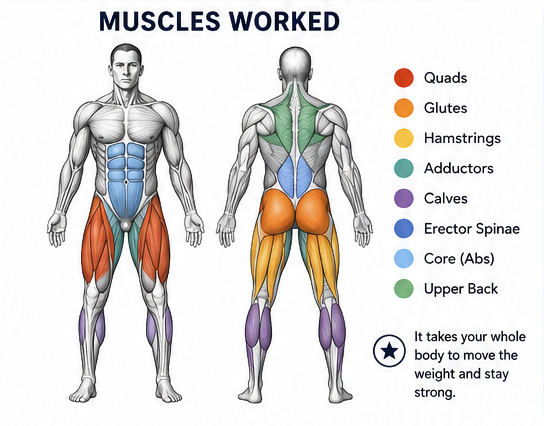
Yes, the quads matter. They help extend the knee and drive you out of the bottom. But a strong squat also requires the posterior chain — the glutes, hamstrings, adductors, and spinal erectors — to work together.
Your glutes help extend the hips.
Your hamstrings and adductors help control the bottom position and support the drive up.
Your spinal erectors help keep the back rigid.
Your abs and trunk help create pressure and stability.
Your upper back helps support the bar.
Your feet help create balance and force against the floor.
This is why the back squat is such a powerful strength builder. It requires the whole body to organize around a heavy load.
That is also why good mechanics matter.
Why We Cue “Knees Out”
One of the most common coaching cues in the squat is “push your knees out.”
And one of the most common questions is: why?
The short answer is that pushing the knees out helps create a stronger, more stable, and deeper squat position.
But there is more going on than people realize.
First, let’s clear something up: when coaches say “knees out,” we are not asking you to shove your knees dramatically sideways or force an exaggerated position. We are usually asking you to keep your knees tracking in line with your toes and avoid collapsing inward.
For many athletes, especially under load, the knees naturally want to cave inward — something called knee valgus. Sometimes this happens because of weakness, fatigue, poor balance, lack of awareness, or mobility restrictions.
A very common place to see this is coming out of the bottom of the squat.
An athlete hits depth, starts to stand up, and suddenly the knees drift inward as they try to drive out of the hole.
Why does this happen?
Usually, it happens because the athlete loses tension or position as the lift gets hard, and the body starts looking for another way to finish the rep.
As the squat gets hard, the hips may stop contributing effectively, fatigue sets in, or the athlete loses tightness. The knees cave inward because the body is trying to recruit different muscles and find a way to finish the rep.
Sometimes it is a strength issue. Sometimes it is a coordination issue. Sometimes it is simply too much load for the athlete to control with good mechanics.
A little movement is not automatically catastrophic — heavy lifts are messy sometimes — but repeated or dramatic knee collapse is usually a sign that something is breaking down.
When the knees collapse inward, several things happen:
You lose tension through the hips.
The feet often collapse inward.
Balance shifts poorly.
The squat becomes less stable.
Power transfer becomes less efficient.
The lift often feels harder than it should.
Pushing the knees out helps solve these problems.
1. It Creates Space for Depth
One major reason pushing the knees out helps is simple geometry.
As you squat, your hips need room to move between your legs.
If the knees stay too narrow or collapse inward, the femur can run into the front of the pelvis sooner, making depth feel blocked or cramped. By allowing the knees to move outward in line with the toes, the hips often have more room to descend.
For many athletes, this instantly makes below-parallel squats feel smoother and more natural.
This is especially true for athletes with larger thighs, limited ankle mobility, longer femurs, or certain hip structures.
Sometimes the cue “knees out” is really a cue for making room to squat deeper.
2. It Helps Engage the Hip Muscles
Pushing the knees out also helps recruit muscles around the hips that stabilize the squat.
The glutes — especially the glute medius and other hip abductors — help control the position of the femur and pelvis. These muscles resist the knees collapsing inward and help stabilize the hips under load.
Think of them as part of the system that keeps your squat organized.
When athletes actively create tension by spreading the floor apart or gently driving the knees outward, they often feel more stable and stronger because the hips are contributing more effectively.
This becomes especially important on the way up.
If your knees cave inward as you stand, it often means the hips are losing position or failing to contribute effectively. Creating tension through the hips and keeping the knees tracking with the toes helps you stay stronger through the sticking point.
This does not mean the abductors are the prime movers of the squat. Your quads and glutes still do most of the heavy lifting. But the abductors help stabilize the movement and maintain better positioning.
A stable hip creates a stronger squat.
3. It Helps Maintain Foot Pressure and Balance
The knees and feet work together.
When the knees cave inward, the arches of the feet often collapse and pressure shifts awkwardly toward the inside of the foot.
When the knees track with the toes, athletes are more likely to maintain a stable tripod foot:
Big toe.
Little toe.
Heel.
That stable foot position helps you stay balanced over the middle of the foot and produce force into the ground.
Better balance means better power.
4. It Helps You Stay Tight Under Load
A good squat is a tension problem.
You are trying to organize the body around a heavy load and maintain position while moving through space.
Driving the knees out slightly can help athletes create tension through the hips and trunk, especially in the bottom position where people often collapse or lose tightness.
Many athletes describe this as feeling “connected” or “stronger” in the hole.
Again, the goal is not exaggeration. The goal is tension and control.
What To Do If Your Knees Cave In Coming Up
If your knees consistently collapse inward as you stand up, do not panic — but do pay attention.
Usually the fix is not one magic mobility drill.
Instead, think:
Lighter load, better positions.
If mechanics fall apart every rep, the weight may simply be too heavy right now.
Drive the knees with the toes.
Think “knees track with toes” instead of forcing them wide.
Spread the floor.
Imagine gently pushing the floor apart with your feet to create hip tension.
Slow the movement down.
Tempo squats and pause squats can improve awareness and control.
Strengthen the pattern.
Goblet squats, split squats, tempo work, and consistent practice often clean this up over time.
Most importantly: do not ignore it, but do not catastrophize it either.
The goal is progress, not perfection.
What “Knees Out” Does Not Mean
This cue gets misunderstood all the time.
“Knees out” does not mean:
Shove your knees as wide as possible.
Force an unnatural position.
Roll onto the outside edges of your feet.
Ignore your natural stance.
The better cue is often:
Knees track with toes.
If your toes are turned out slightly, your knees should generally move in that direction too.
For some athletes, “knees out” is a powerful cue because they tend to cave inward. For others, it may barely need emphasis at all.
The goal is alignment, tension, and stability — not exaggeration.
Rigid Back, Not Necessarily Vertical Back
One of the most helpful ways to think about the squat is this: the goal is a rigid back, not necessarily a vertical back.
A lot of athletes think a good squat means the chest must stay perfectly upright the whole time. But depending on your body type, stance, ankle mobility, hip structure, and bar position, your torso may lean forward slightly.
That is not automatically wrong.
The problem is not a forward torso angle. The problem is a loose, rounded, or collapsing back.
This distinction matters because many people get worried when they feel their torso angle change during a squat. They think any forward lean means they are doing something wrong or putting their low back at risk.
But the low back is not protected by trying to stay perfectly vertical. The low back is protected by bracing well, keeping the spine organized, and loading a position you can control.
Your trunk has to act like a strong bridge between the barbell and the legs. If the brace disappears, the bar gets heavy fast. The torso softens, the chest drops, the hips shoot up, and the lift can turn into something that looks more like a good morning than a squat.
That is what we want to avoid.
A good squat uses the hips and legs together while the back stays locked in. The torso angle may look different depending on the athlete, but the back should not be loose.
This is why we coach:
Brace before you descend.
Keep your ribs and pelvis connected.
Stay tight through the bottom.
Drive hips and shoulders up together.
Do not let the chest collapse as you stand.
A strong low back is not something we avoid using. It is something we train to support good movement.
In a strong squat, the back stays tight, braced, and strong. The torso angle may look a little different from person to person, but the standard is the same: brace hard, stay tight, and keep the bar balanced over the middle of the foot.
Bar Over Mid-Foot
One of the simplest ways to understand squat mechanics is to think about balance.
The bar needs to stay over the middle of the foot.
If the bar drifts too far forward, you’ll feel yourself shift onto your toes. The lift gets harder, your position gets worse, and you lose power. If you shift too far back, you lose balance the other way.
A strong squat happens when the whole system — barbell and body — stays balanced over the mid-foot.
That is why we cue:
Full foot on the floor.
Brace before every rep.
Knees track with toes.
Hips back and down.
Stay tight in the bottom.
Drive up with the hips and shoulders together.
These are simple cues, but they matter.
Why We Squat Below Parallel
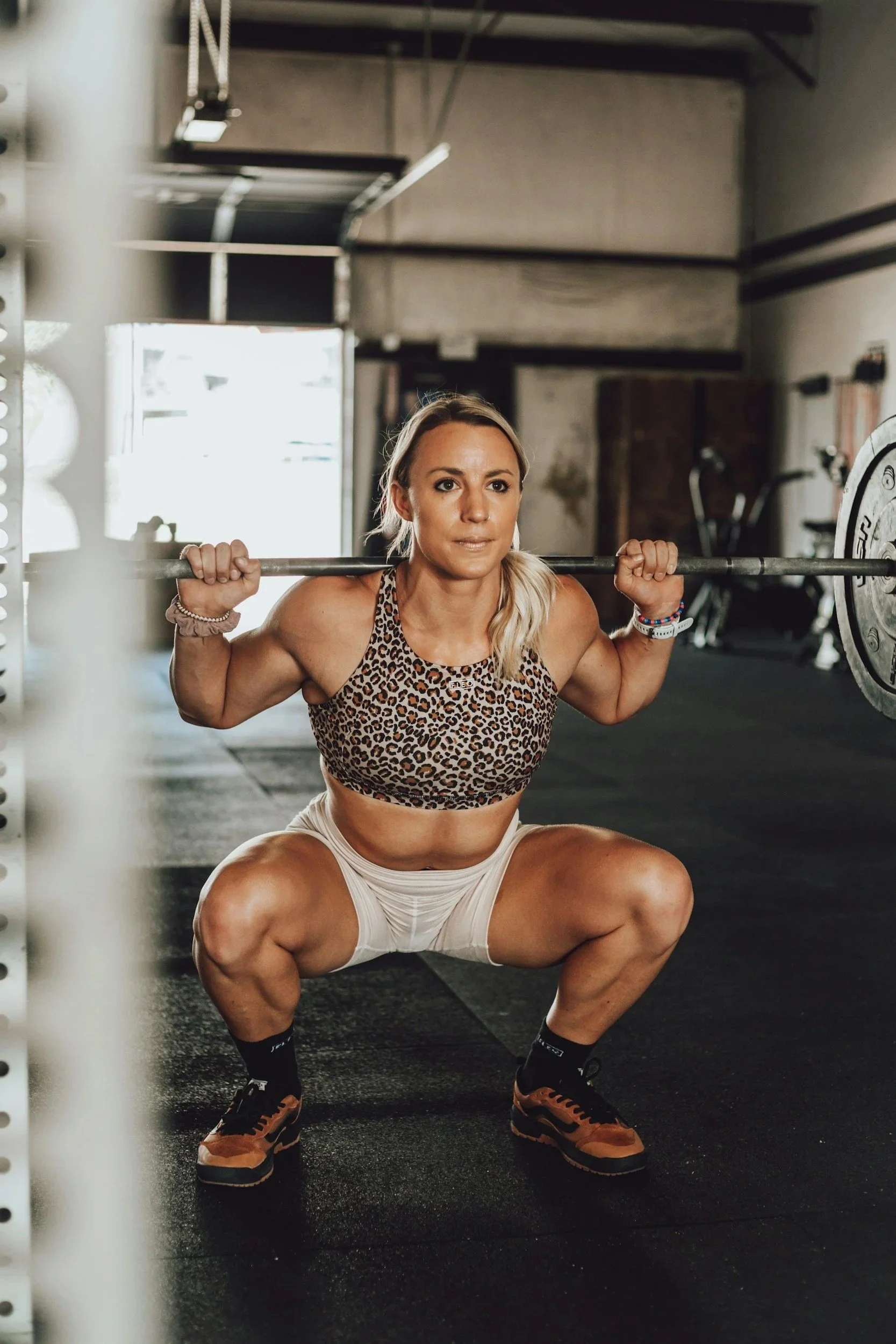
At CrossFit Travelers Rest, we teach and train the squat to below parallel. That means the crease of the hip passes below the top of the knee.
This is not just a CrossFit standard. It is not just a judging rule. It is not just something we do to make the movement harder.
We squat below parallel because full range of motion matters.
A below-parallel squat trains strength through a deeper range. It asks the hips, knees, and ankles to move well. It recruits more muscle. It builds control in the bottom position. It teaches the body to be strong where many people are weak or uncomfortable.
When people cut depth short all the time, they may be able to lift more weight in the short term, but they are also skipping a major part of the movement. They miss the opportunity to build strength and control through the full range.
Depth matters because life is not always partial range of motion.
Sometimes you have to get low. Sometimes you have to stand up from a low position. Sometimes you have to control your body near the ground. Training below parallel helps build that ability.
“I Don’t Think I Can Squat Below Parallel”
A lot of people believe they physically cannot squat below parallel.
Sometimes that belief comes from stiffness, discomfort, old injuries, fear, body proportions, or simply never having practiced the movement.
And to be fair, some athletes truly do have mobility restrictions or limitations that make depth difficult at first.
But “not yet” is different from “never.”
If you cannot comfortably squat below parallel today, that does not mean you are broken or incapable. It means we meet you where you are and build from there.
We can adjust stance width.
We can change toe angle.
We can reduce load.
We can use goblet squats or box squats.
We can slow the movement down with tempo work.
We can improve ankle, hip, or thoracic mobility.
We can build confidence and control gradually.
For many athletes, depth improves over time as strength, mobility, coordination, and confidence improve together.
The goal is not to force your body into a painful position. The goal is to safely expand what you are capable of.
Most people are more capable than they think — especially with coaching, patience, and practice.
Are Deep Squats Bad for Your Knees?
This is one of the most common concerns people have.
The short answer: properly performed squats are not the enemy.
Poor mechanics, too much load too soon, lack of control, or forcing positions your body is not ready for can create problems. But the answer is not to avoid squatting. The answer is to squat better.
When we squat well, we strengthen the muscles around the knees, hips, and trunk. We build control. We improve mobility. We learn how to move with better balance and awareness.
For some athletes, below parallel may not be perfect on day one. That is okay. We can adjust stance, load, tempo, range of motion, or variation. Some athletes may need box squats, goblet squats, tempo squats, pause squats, or mobility work to get into better positions.
Scaling is not failure. Scaling is how we train the right movement for the person in front of us.
The goal is not to force everyone into the same-looking squat. The goal is to help every athlete move better, get stronger, and build confidence over time.
Everyone’s Squat Will Look a Little Different
Not every squat will look exactly the same.
Some athletes have long femurs. Some have shorter torsos. Some have limited ankle mobility. Some have tight hips. Some have shoulder limitations that affect how they hold the bar. Some people naturally squat better with a slightly wider stance or toes turned out a little more.
That does not mean the standard disappears.
We still want the full foot on the floor.
We still want knees tracking with toes.
We still want a braced trunk.
We still want the hip crease below the knee.
We still want control through the full movement.
But how an athlete sets up may vary.
This is where coaching matters. The right stance, the right bar position, the right cue, and the right load can make a huge difference.
What to Focus on When You Squat
When we back squat, quality comes first.
Not every rep needs to be maximal. Not every set needs to feel like a personal record. Strength is built through consistent, repeatable work.
Here are the big priorities:
Brace before every rep.
Take your breath, create pressure, and get tight before you move.
Keep your full foot on the floor.
Big toe, little toe, and heel stay connected to the ground.
Knees track with toes.
Don’t let the knees cave in. Push them out and keep them aligned.
Squat below parallel.
Hip crease below the top of the knee. Depth before load.
Stay tight in the bottom.
Do not relax or collapse. Own the bottom position.
Drive up with control.
Push the floor away and drive the hips and shoulders up together.
Add weight only when positions stay solid.
The goal is not just heavier squats. The goal is stronger squats.
Strength Takes Time
Strength is built through consistency.
One great squat day is nice. But real progress comes from showing up, practicing the movement, building confidence under the bar, and giving the body time to adapt.
Some days the bar will feel light. Some days it will feel heavy. Some days your depth will feel better than others. Some days your positions will click. Some days you’ll need to slow down and focus on the basics.
That is all part of the process.
The important thing is that we keep showing up, keep working on positions, and keep stacking quality reps.
Final Thought
We back squat because strength matters.
It matters for CrossFit.
It matters for sport.
It matters for daily life.
It matters for aging well.
It matters for confidence.
The back squat teaches us how to brace, how to stay tight, how to use our hips and legs together, how to control our body through a full range of motion, and how to stand up under load.
That is a skill worth building.
Move well.
Hit depth.
Stay tight.
Be consistent.
Trust the process.
Strong positions create strong squats. Strong squats create stronger people.