
Why We Squat, how we squat & why it matters
If there’s one movement that shows up everywhere—in the gym and in real life—it’s the squat.
You sit down. You stand up. You pick things up. You get off the floor. Every one of those starts with a squat.
At CrossFit, we don’t just squat—we emphasize doing it well, doing it often, and doing it to a standard that actually builds strength for life.
Squatting Is a Life Skill
The squat is one of the most foundational human movements. Long before barbells, people lived in a squat—resting, working, and moving from the ground.
As we get older, this ability tends to disappear.
That’s a problem.
Loss of leg strength and the ability to stand up from a seated position is one of the biggest predictors of reduced independence. The simple act of getting off the couch, out of a chair, or up from the ground becomes harder—not because aging demands it, but because we stop training it.
Squatting keeps that ability.
It builds:
Strength in the legs and hips
Stability in the knees and ankles
Balance and coordination
Confidence moving through full ranges of motion
If you want to stay capable as you age, you need to squat.
Why CrossFit Demands Squats Below Parallel
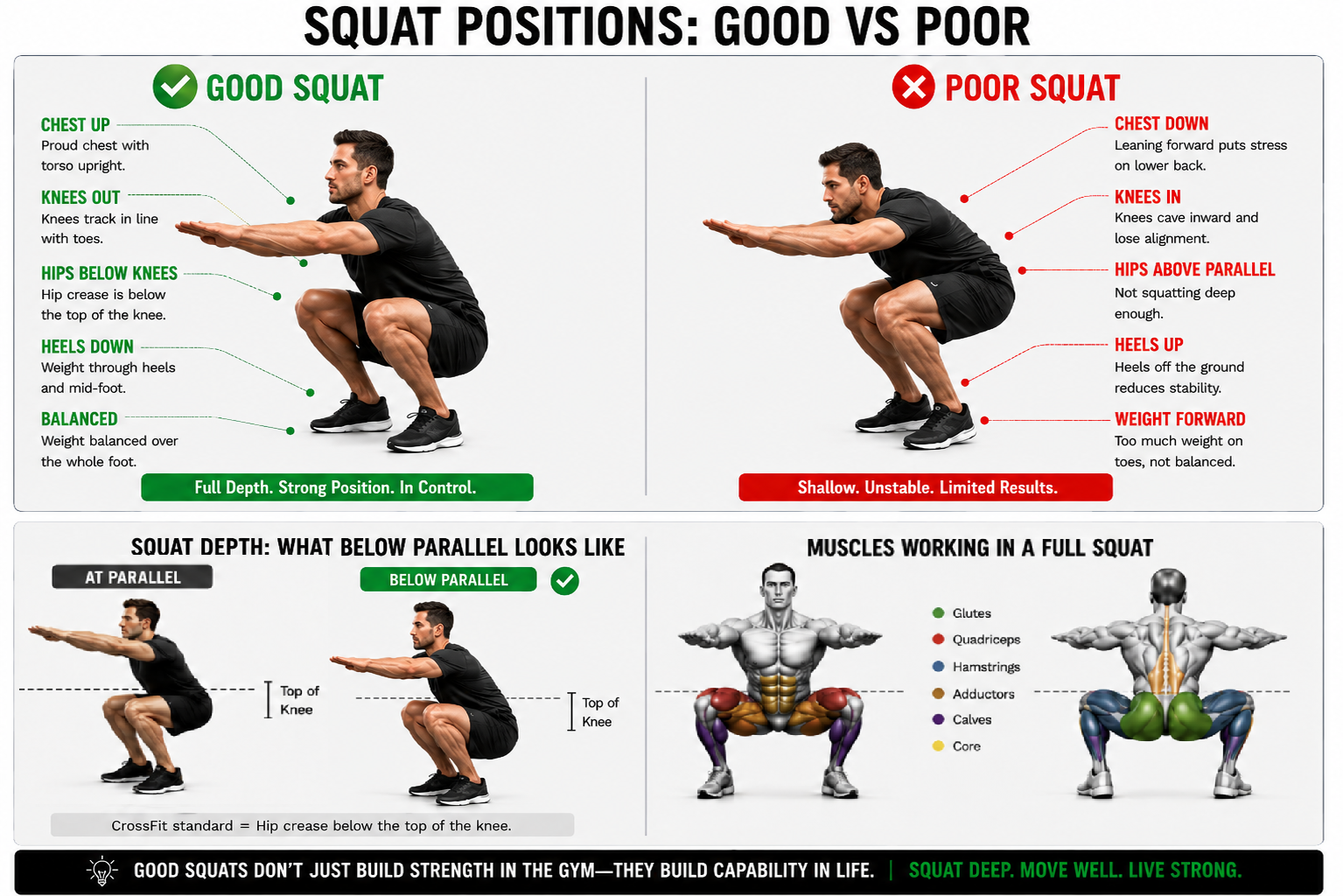
At CrossFit, we define a squat as reaching a position where the hip crease drops below the top of the knee.
That standard isn’t arbitrary—it’s intentional.
Partial squats (above parallel) are easier. They require less range of motion, less strength, and less control. But they also deliver fewer results.
When you squat below parallel, you:
Train through a full range of motion
Build strength where you're weakest (the bottom)
Develop better joint health and mobility
Recruit more muscle
In short: you get more out of every rep.
Why Below Parallel Is Harder (And Better)
Breaking parallel changes everything.
Above parallel, you’re relying heavily on your quads and staying in a relatively strong mechanical position.
Once you drop below parallel:
Your hips travel further back and down
Your hamstrings and glutes become heavily involved
You must stabilize your spine and core more aggressively
You lose mechanical advantage and have to produce force out of the bottom
That “bounce” out of the hole? That’s stored tension in the posterior chain doing its job.
This is where real strength is built.
The Muscles That Make the Squat Work
A full squat isn’t just a leg exercise—it’s a total-body movement.
Here’s what’s working when you squat below parallel:
Glutes – Primary driver out of the bottom
Hamstrings – Assist with hip extension and control the descent
Quadriceps – Extend the knee and drive you to standing
Adductors – Stabilize and assist in hip extension (especially deep)
Core – Maintains spinal position under load
Erector Spinae – Keeps your chest up and spine neutral
Calves and Ankles – Provide stability and balance
The deeper you squat (with good mechanics), the more these systems are engaged together.
Common Squat Misconceptions (Let’s Clear These Up)
There’s a lot of bad information out there about squatting—most of it rooted in trying to make the movement easier, not better.
“Your Knees Shouldn’t Go Past Your Toes”
In a natural squat, your knees will travel forward. That’s normal—and necessary.
Trying to stop them:
Pushes your hips too far back
Forces your chest forward
Increases stress on your lower back
Letting the knees move naturally:
Keeps your torso more upright
Improves balance
Distributes load across the entire leg
The goal isn’t to limit the knees—it’s to control them.
“Squatting Deep Is Bad for Your Knees”
This is one of the biggest myths.
According to foundational CrossFit resources like the Squat Clinic and Science of Squatting, full-depth squats—done correctly—are actually safer.
At full depth:
The glutes and hamstrings help stabilize the knee
Load is shared across more muscle groups
You avoid the high stress that often occurs in partial squats
Deep squats protect your knees. Poor mechanics don’t.
“I’m Not Flexible Enough to Squat”
Most people aren’t lacking mobility—they’re lacking exposure.
Your body is designed to squat. You just have to practice it again.
“Squats Are Just a Leg Exercise”
A heavy set of squats proves otherwise.
Your core, back, hips, and legs are all working together. That’s why the squat transfers so well to everything else we do.
How We Get Better at Squatting
One of the biggest takeaways from CrossFit’s methodology is this:
The squat is a skill.
Before load, we focus on positions:
Heels down
Knees tracking over toes
Full depth
Stable spine
Upright torso
Fix the movement first. Strength will follow.
The “Immature Squat” (And How We Fix It)
Kids squat perfectly. Adults don’t.
An immature squat looks like:
Heels lifting
Knees collapsing inward
Shallow depth
Chest falling forward
This isn’t a permanent limitation—it’s just a lack of practice.
We improve it by:
Slowing the movement down
Using lighter loads
Spending time in the bottom
Repeating good reps consistently
You don’t need a different body—you need better reps.
Ankle Mobility: The Hidden Limiter
If your ankles don’t move, your squat suffers.
Limited ankle mobility leads to:
Forward chest lean
Heels coming up
Difficulty hitting depth
That’s why small changes (like lifting your heels) can instantly improve your squat.
But long term, we want to fix the root issue.
Simple ways to improve:
Spend time sitting in a deep squat
Perform slow, controlled reps
Do calf and Achilles mobility work
Use goblet squats to reinforce good positioning
Better ankles = better squats.
Why We Keep Working on It—Every Time
You never “finish” your squat.
Even advanced athletes are constantly improving:
Balance
Control
Strength in the bottom
Mobility
Every rep is practice.
That’s why we coach it every day. Not because you’re doing it wrong—but because it can always be better.
Squatting and Longevity
The squat builds strength where it matters most:
Hips
Legs
Core
More importantly, it builds independence.
A strong squat means:
You can get off the ground
You can move safely
You can handle real-life demands
That’s not gym strength—that’s life strength.
Why We Prioritize It at Our Gym
We squat often because it works.
You’ll see:
Back squats for strength
Front squats for posture and core
Air squats for mechanics
Squatting under fatigue in workouts
We hold the standard because it matters.
Final Thought
You don’t stop squatting because you get older.
You get older—and lose capability—because you stop squatting.
So we train it.
We train it well.
References:
CrossFit Journal: Squat Clinic
The Science of Squatting: Unlocking Strength, Safety, and Performance in CrossFit