
Hydration and Electrolytes: What You're Actually Losing in a WOD
CrossFit Travelers Rest | Member Nutrition Series
The Short Version
August in Travelers Rest means every class is a heat class. If your only hydration plan is "drink water," you're solving half the problem — and in a long or hot WOD, plain water can actually make things worse. What you sweat out during a workout is water and electrolytes, mainly sodium. Replace only one of those and you're still behind.
What You're Actually Sweating Out
During a hard 45–60 minute session, sweat rates commonly run 1–2 liters per hour, and that number climbs in heat and humidity — exactly the conditions we're training in right now. Every liter of that sweat carries roughly 400–600mg of sodium out with it, along with smaller amounts of potassium, magnesium, and calcium. Sodium loss varies a lot person to person — some athletes lose two or three times what others do in the same class — which is why "just drink more water" isn't a one-size-fits-all fix.
Why Water Alone Isn't Enough
Here's the part most people miss: chugging plain water after a grueling WOD doesn't restore what you lost — it dilutes what's left. Drinking more fluid than your body actually lost and can process is the single most preventable cause of exercise-associated hyponatremia (dangerously low blood sodium). It's rare, but it's real, and it's more likely in longer efforts, hot conditions, and athletes who over-hydrate with water alone and skip sodium entirely.
The fix isn't drinking less. It's drinking smart — matching fluid to what you're actually losing, sodium included.
How Much You Need
Before class: Show up hydrated, not over-hydrated. You're aiming to start within about 1% of your normal body weight — not chugging a liter right before the warm-up.
During and after: For anything over about an hour — a long class, an open gym session, a competition — sports science bodies recommend 0.5–0.7g of sodium per liter of fluid. For a standard hour-long class in normal conditions, you likely don't need a dedicated electrolyte strategy. In August heat, on a longer or more metabolically demanding day (think a 20+ minute grinder or a hot afternoon class), that's exactly when electrolytes matter most.
A simple gut check: weigh yourself before and after a hard, hot session. Losing more than about 2% of your body weight means you were behind on fluids during the workout — drink accordingly next time, and don't wait until you're thirsty to start.
Signs You're Behind
Cramping, especially late in a workout or that evening
Headache or dizziness after class that doesn't clear up quickly
Unusual fatigue or a workout that felt harder than it should have
Dark yellow urine (a rough but useful daily indicator)
Salty, crusted sweat on your shirt or hat — a sign you're a "salty sweater" who loses more sodium than average
If any of these are showing up regularly, especially in the next few weeks of heat, it's worth adding sodium back in deliberately rather than just drinking more water.
What Isn't Hydration: Soda, Gatorade, and the Sports Drink Aisle
Not everything in a bottle at the gas station is doing what you think it's doing.
Soda isn't a hydration strategy under any circumstances. It's water, sugar (or an artificial sweetener), caffeine, and carbonation — with essentially no sodium or potassium. At normal intake levels, caffeine doesn't meaningfully dehydrate you, so an occasional Coke isn't sabotaging your training. But it replaces none of what you actually lost in sweat, and roughly 39g of sugar in a 12oz can with zero electrolytes is the wrong trade if hydration is the goal.
Gatorade, Powerade, and similar "sports drinks" are closer to soda than most people assume, and belong in the "not real hydration" category for two specific reasons. First, the sugar: a 20oz Gatorade Thirst Quencher carries 270mg of sodium — a fraction of what a hard, hot hour of training costs you — against 36g of added sugar, mostly sucrose and dextrose. That's a sugar load without a sodium payoff to match it. Second, the dyes: most flavors rely on artificial colors like Yellow 5, Yellow 6, or Red 40, which exist purely to make the drink look a certain color on shelf — they do nothing for hydration, electrolyte replacement, or performance. It's not an evil product; Gatorade was formulated in the 1960s for football players sweating through multiple hours of practice in extreme heat, not a 45-minute WOD. Powerade follows the same playbook — sugar and dye first, sodium a distant second.
The quick label check: compare sodium (in milligrams) to sugar (in grams). If the sugar number dwarfs the sodium number, you're drinking a flavored soft drink with a sports marketing budget, not a real electrolyte replacement.
One nuance worth knowing: a small amount of glucose or dextrose in a formula isn't automatically bad — it actually helps your gut absorb sodium faster through the same transport pathway. That's a different thing from 30-plus grams of sugar added purely for taste. The dose is what separates a legitimate hydration product from a soft drink in athletic packaging.
Comparing Electrolyte Brands
Here's how the brands members actually ask about stack up, sorted by sodium content. All figures are per single serving (one stick pack, tablet, or scoop). One label-reading note first: most brands list elemental sodium in milligrams, but a couple (like Saltt) list the weight of the salt compound itself, which reads higher than the actual sodium content — worth knowing so you're not comparing apples to oranges on the shelf.
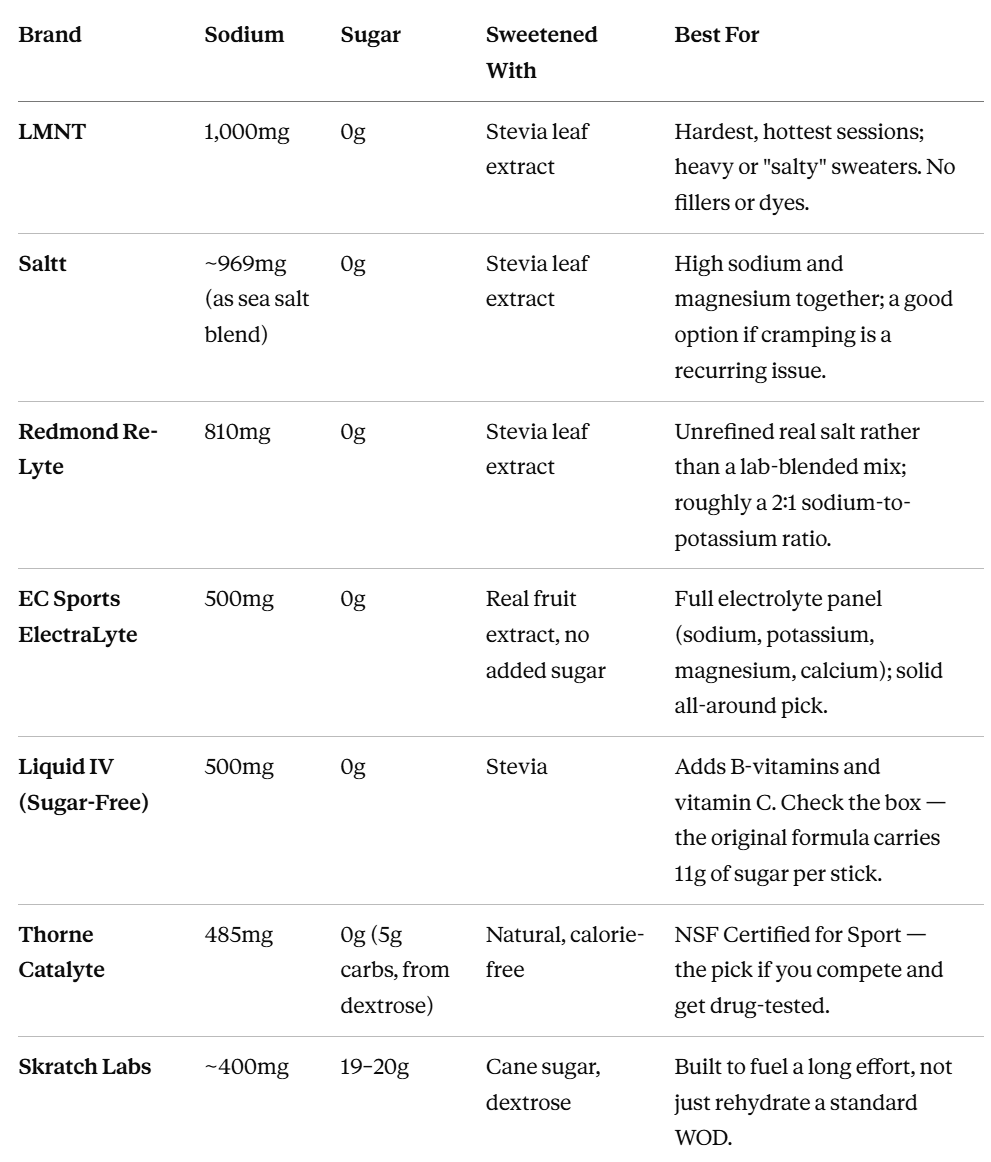
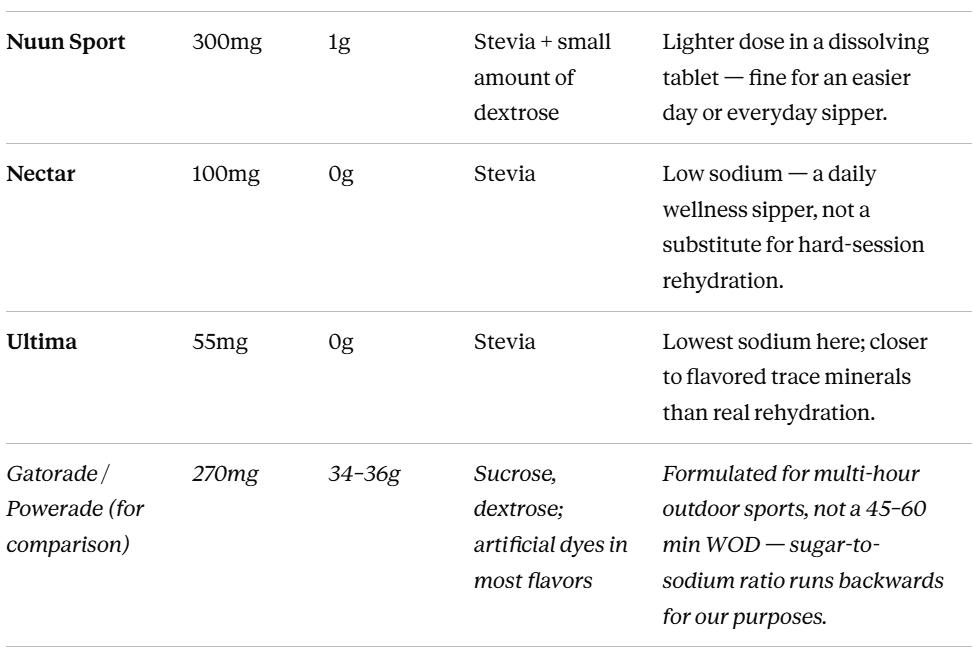
Bottom line: for a hard, hot class, LMNT, Saltt, and Re-Lyte give you the highest sodium payoff with zero sugar. EC Sports, Liquid IV Sugar-Free, and Thorne (especially if you compete) are all solid runners-up. Nuun works fine for lighter days. Skratch and full-sugar Liquid IV make more sense if you're also fueling a long effort, not just rehydrating. Nectar and Ultima are better thought of as daily hydration habits than a replacement for what you lose in a hard WOD.
What's Actually in These: An Ingredient Glossary
Electrolyte labels are short, but they're full of names nobody explains. Here's what shows up most often and what it's actually doing:
Citric acid / malic acid — flavor acids (citric from citrus, malic from apples). They add tartness and brightness and help the drink taste less flat. Not electrolytes themselves, just flavor.
Magnesium malate — magnesium bound to malic acid. Your body absorbs this organic form more efficiently than magnesium oxide (the cheaper form found in some budget products), so it matters a bit if magnesium or cramping is a specific concern for you.
Potassium (chloride, citrate, or malate) — the second-most important electrolyte after sodium. Brands bind it to different acids for solubility and taste, but the potassium itself does the same job regardless of which form it's attached to.
Silicon dioxide / calcium silicate — anticaking agents. Their only job is keeping powder from clumping in a humid stick pack. Used in tiny amounts, considered safe by food regulators, and contribute nothing to hydration one way or the other.
Acacia gum — a plant fiber used as a thickener and binder (also a mild prebiotic fiber). It's filler in the literal sense, but a harmless, well-tolerated one — not a red flag on a label.
Not All Salt (or Stevia) Is the Same
On salt sources: brands source their sodium differently — plain sodium chloride (table salt), sea salt, Himalayan pink salt (EC Sports), or mineral-rich salt mined from an ancient seabed (Redmond's Real Salt, used in Re-Lyte; Saltt's "Solar Sea Salts"). The marketing around these — "84 trace minerals," "ancient seabed" — is mostly noise. The trace mineral amounts are genuinely tiny next to what you get from food, and there's no solid research showing pink or ancient salt outperforms plain sea salt for hydration. What actually matters across all of them is the sodium number on the label, not the backstory.
On stevia: not all stevia is identical. Most commercial products use Rebaudioside A (Reb A) — the purified, sweetest compound isolated from the stevia leaf, and the only form the FDA recognizes as safe for food use. Whole-leaf or "crude" stevia extract includes other compounds that carry a more bitter, licorice-like aftertaste — and it isn't FDA-approved as a food additive in the first place. If one brand's stevia tastes noticeably more bitter than another's, that's a purity/blend difference, not a health difference.
On allulose: you'll see this on a couple of labels and it looks like a sugar (it's technically classified as one), but it isn't metabolized the way regular sugar is — it passes through mostly unused, with close to zero calories and no real blood sugar impact. It's a legitimate sweetener choice, not something to avoid just because the word "sugar" is nearby.
Sweeteners and Fillers to Actually Watch Out For
Most reputable electrolyte brands already avoid these, but they're common enough in gas-station and bargain-bin products to name directly:
Sucralose, acesulfame potassium (Ace-K), and aspartame — the standard artificial sweetener trio. Regulators consider them safe within normal intake limits, but a growing body of research links them to measurable shifts in gut bacteria and, for Ace-K specifically, glucose intolerance. With nearly every quality electrolyte brand using stevia or allulose instead, there's no reason to reach for one that still uses these.
Erythritol — a sugar alcohol common in "keto"-branded products. A 2023 Cleveland Clinic study (published in Nature Medicine) linked elevated blood erythritol levels to increased clotting activity and higher cardiovascular event rates — though the study was observational and skewed toward people already at elevated cardiovascular risk, not healthy training athletes. It's not a reason to panic over an occasional packet, but it's a reasonable tiebreaker in favor of a stevia- or allulose-sweetened product when you have the choice.
Maltodextrin — a cheap, starch-derived filler carb that spikes blood sugar despite often getting marketed as "not sugar." It shows up in some budget electrolyte and pre-workout powders as a bulking agent. Worth a second look on any label that claims "no sugar" but still lists this high up.
Artificial dyes (Yellow 5, Yellow 6, Red 40, Blue 1) — cosmetic only, as covered above with Gatorade and Powerade. They don't hydrate you or do anything nutritionally; they just make the drink look a certain color.
The Practical Takeaway
Hydrate steadily through the day — not all at once before class.
Add sodium on long or hot days — not every session needs it, but August ones probably do.
Weigh in, weigh out on a hard day to see where you actually stand.
Watch for cramping, headaches, and salty sweat — your body's telling you something.
Skip soda and traditional sports drinks as a hydration strategy — check the label, and let sodium (not sugar) be the number you're chasing.
Read past the marketing — sodium content is what matters, not "84 trace minerals" or an ancient seabed story. Skip sucralose, Ace-K, aspartame, and maltodextrin when you have a choice.
Water gets you most of the way there. Sodium is what closes the gap — especially this time of year.